Francophonie 4.0 Forum: Philippe Araujo, Director of YULCOM AI UK, Emphasizes That Artificial Intelligence Should Give Us More Time for Meaningful Human Interaction
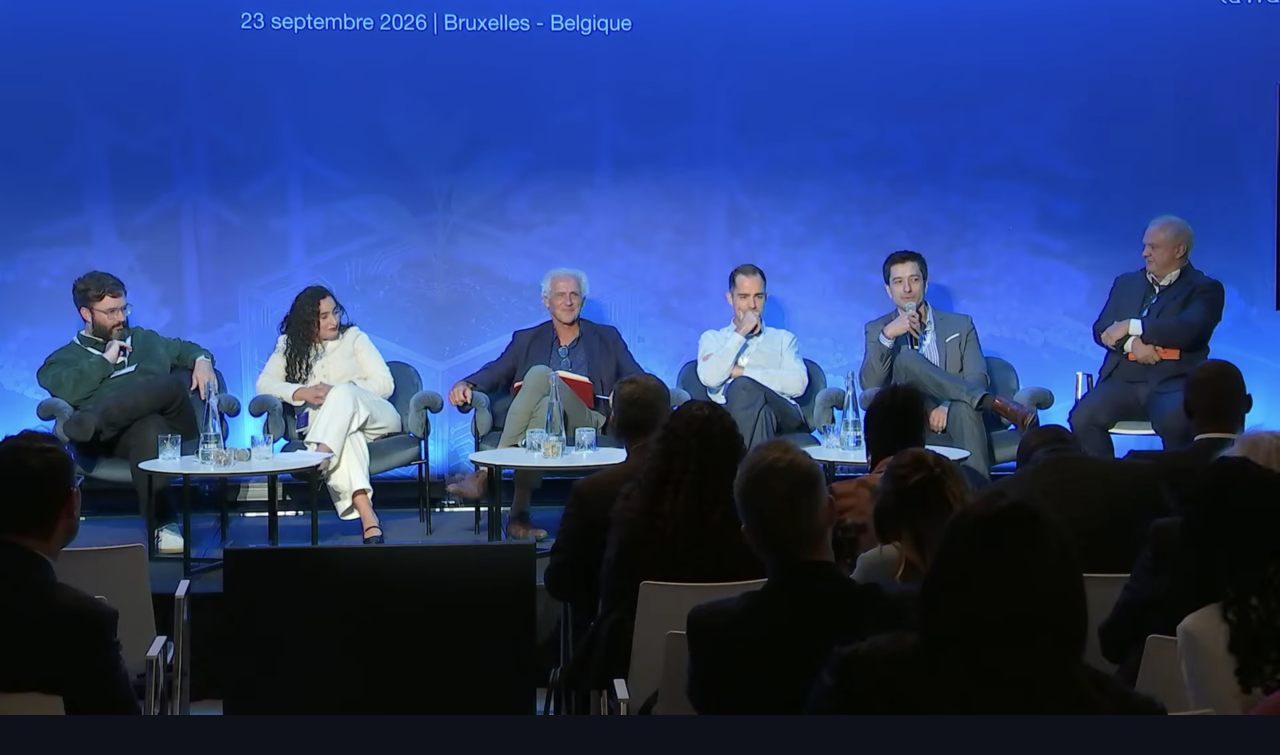
On September 23, 2026, Philippe Araujo, Director of YULCOM AI UK, took part in the inaugural Francophonie 4.0 Forum, organized in Brussels by the International Organisation of La Francophonie (OIF).
Focused on artificial intelligence, employment, and local innovation, this multi-stakeholder forum sought to identify pathways toward inclusive and sustainable development across the French-speaking world by 2030.
Drawing on more than ten years of experience in the design, deployment, and adoption of artificial intelligence solutions, Philippe Araujo contributed to the first panel, entitled “Artificial Intelligence and La Francophonie: Opportunities for Employment.” He offered a highly practical, field-oriented perspective informed by YULCOM’s work with businesses, institutions, and entrepreneurs.
Preserving Human Creativity in the Age of Artificial Intelligence
When asked about the use of AI in literature, music, and other creative fields, Philippe Araujo adopted an open yet discerning position.
He explained that artificial intelligence can reproduce structures, generate text, compose music, and create impressive images. However, it cannot fully replicate the soul, culture, sensitivity, and unique lived experience of a human being.
The central issue, therefore, is not to prohibit AI-assisted creation but to ensure transparency. In artistic and literary competitions, Philippe Araujo recommended establishing clear rules and, where appropriate, creating separate categories for works produced “with AI” and “without AI.”
Such an approach would encourage technological experimentation while protecting creators, their rights, and recognition of their contribution.
Watch the full video of the Francophonie 4.0 Forum below
Automating Tasks to Create More Time for Human Interaction
Philippe Araujo also emphasized that the primary purpose of automation should be to free professionals from repetitive tasks so that they can focus on activities that deliver greater human value.
He uses artificial intelligence to conduct certain types of research, organize information, and prepare initial drafts. The goal is not to delegate decisions or communication entirely, but to create a starting point that the user can review, personalize, and refine.
To illustrate this approach, he shared the example of sales teams supported in their use of AI. Automated portfolio analysis helped them identify prospects and customers who had not been contacted for several months.
With this information, sales professionals were able to regain control of their follow-up activities, determine which relationships needed attention, and devote more time to meaningful conversations with customers. From this perspective, artificial intelligence does not replace human relationships; it helps restore and strengthen them.
Making Data Sovereignty a Strategic Priority
Data sovereignty was another central theme of Philippe Araujo’s contribution.
Organizations need to know where their data is stored, how it is used, and under what conditions it may be shared with external services. This requirement is especially important in the legal, financial, and public sectors, where the information processed may be sensitive or confidential.
In these contexts, Philippe Araujo recommended considering open models that can be deployed on an organization’s own servers. This approach enables organizations to benefit from artificial intelligence while retaining control over their data and infrastructure.
He also noted that technological sovereignty depends on the availability of resources. In many African countries, key barriers still include insufficient digitized data, limited access to computing power, and the high cost of technological infrastructure.
Based on entrepreneurship training programs delivered across Africa, he nevertheless sees considerable potential. The ideas and skills are already present, but they must be supported by better access to data, technology, infrastructure, and computing resources.
Transforming Jobs Rather Than Simply Eliminating Them
On the future of work, Philippe Araujo presented a nuanced perspective. AI does not necessarily lead to the complete disappearance of occupations. Instead, it automates certain tasks and compels professions to evolve.
He cited the example of IKEA, which automated part of its customer service operations while retraining 8,500 employees to become remote interior design advisers. This example demonstrates how a company can use automation as a driver of workforce transition and new service creation.
According to Philippe Araujo, it remains difficult to predict exactly what occupations will look like in the coming years. What is clear, however, is that adaptability will become essential.
Human capabilities—including creativity, judgment, critical thinking, communication, empathy, and collaboration—will remain decisive. These are precisely the qualities that artificial intelligence systems find most difficult to reproduce.
Preparing Young People Through AI, Entrepreneurship, and Human Skills
In response to these changes, Philippe Araujo recommended that training programs go beyond the technical use of AI tools.
Young people should also develop entrepreneurial abilities, interpersonal skills, problem-solving capabilities, and the capacity to build and mobilize communities. They must learn to use AI to design solutions that respond to local needs and create value within their own environments.
AI-assisted development tools, including “vibe coding,” are now lowering technical barriers. They allow people without advanced programming backgrounds to build applications, test ideas, and launch new ventures.
For the French-speaking world, this democratization represents a major opportunity to support the creation of local businesses and make advanced technologies accessible to a broader community of innovators.
Expanding Access to Knowledge in French While Preserving Cultural Identity
Philippe Araujo also highlighted AI’s potential to democratize access to knowledge in French.
A substantial share of technical, scientific, and digital knowledge continues to be produced or distributed in English. Translation and adaptation tools now allow French-speaking users to access these resources in their own language and benefit more readily from technologies that were once largely restricted to English speakers.
Linguistic translation, however, should not result in cultural standardization. Language carries the references, sensitivities, and ways of thinking of the communities that speak it. Quebec, Congolese, Cameroonian, Togolese, and European realities cannot be fully reproduced by an algorithm through generic translation alone.
The development of French-language AI solutions must therefore reflect the diversity of cultures, practices, and local contexts across the French-speaking world.
A Three-Level Approach to Responsible AI Use
To reduce errors and prevent users from accepting AI-generated responses at face value, Philippe Araujo proposed a structured approach built around three levels.
The first involves properly personalizing and configuring the model according to the user’s profile, objectives, and context.
The second focuses on creating an organizational knowledge base—a form of “second brain”—that brings together validated documents, knowledge, and references. The AI system can then rely primarily on a controlled body of information rather than uncertain or overly general sources.
The third level concerns training users in context-rich prompting. Users need to understand that the quality of an AI-generated response depends heavily on the instructions, context, and information provided. They must learn how to guide the tool, verify its outputs, and retain responsibility for the final decision.
AI as a Tool for Empowering French-Speaking Communities
Throughout his contribution, Philippe Araujo advanced a pragmatic vision of artificial intelligence: technology should strengthen people’s ability to act rather than replace them.
His message encourages institutions, businesses, and training providers to move beyond a simplistic opposition between humans and machines. The priority should be to prepare workers, young people, and entrepreneurs to use AI responsibly, critically, and creatively.
YULCOM AI UK’s participation in the Francophonie 4.0 Forum reflects YULCOM’s commitment to advancing artificial intelligence that is accessible, sovereign, and adapted to the realities of French-speaking communities.
For this transformation to benefit the French-speaking world fully, it must be supported by sustained investment in infrastructure, skills development, data governance, French-language content, and locally driven innovation.
During the panel, “Artificial Intelligence and La Francophonie: Opportunities for Employment,” Philippe Araujo was joined by:
- Hugues Bersini — Panel moderator, Professor at the Université libre de Bruxelles, and co-founder of FARI;
- Olivier Bertrand — Professor of Linguistics and Director of the International Centre for French Language and Culture at the Institut Polytechnique de Paris;
- Asmae Ben Bahida — Engineer, artificial intelligence expert, and founder of Just BIM It;
- Steven Tallec — Co-founder of Arvester, a consulting firm specializing in the cultural and creative industries and the discoverability of creative works;
- Carl Mörch — Co-director of FARI and a specialist in responsible artificial intelligence;
- Laetitia Mampaka — Actress, comedian, columnist, and public-speaking coach.